
Losing a tooth feels like a small thing on day one. You smile a little less in photos, you start chewing on one side and you tell yourself you will sort it out later. Then later turns into months, and the gap quietly starts causing trouble you cannot see. If you have been weighing your choices and searching for a Dental Implant in Wakad, you are already asking the right question. The real decision is not just how to fill the gap, it is which option will still be doing its job ten or fifteen years from now. Dentures and bridges have their place, but for most people an implant is the closest thing modern dentistry has to getting your own tooth back.
This guide breaks down how each option actually performs over time, what happens to your jaw when a tooth goes missing and why so many patients in Wakad end up choosing implants once they understand the full picture.
What Really Happens When You Lose a Tooth
A missing tooth is not only a cosmetic gap. The root of every tooth keeps your jawbone active. Each time you bite and chew, the root sends pressure signals into the bone and that stimulation tells your body to keep the bone dense and healthy. The moment a tooth is gone, that signal stops in that spot.
Within the first year the bone in that area begins to shrink. Dentists call this resorption. Over time the cheek can look slightly sunken, neighbouring teeth start drifting into the empty space and the opposing tooth above or below can slowly grow out of its socket because nothing is pushing back against it. So a single gap that felt harmless can quietly change your bite, your face shape and the position of teeth that were perfectly fine.
This is the part most people are never told. The choice you make is not just about today. It is about whether the solution protects the bone and the teeth around the gap, or simply hides the problem on the surface.
The Three Main Options for a Missing Tooth
When you sit in the dentist chair with a gap to fill, you usually hear three names: dentures, bridges and implants. They all replace a tooth, but they work in very different ways and they age very differently.
Removable Dentures
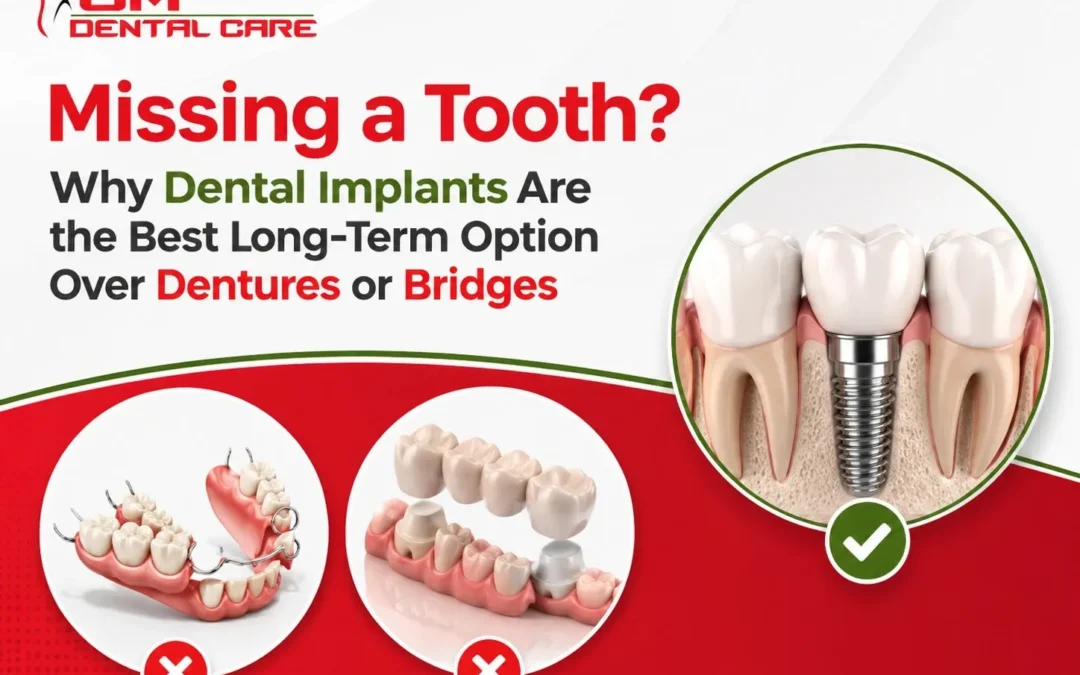
A partial denture is a removable plate that carries one or more false teeth and clips onto the natural teeth nearby. It is the most affordable option and it can be made fairly quickly, which is why many people start here.
The trade off is comfort and stability. Dentures sit on the gums rather than being fixed into the jaw, so they can move while you eat or talk. They need to be taken out and cleaned, they can feel bulky at first and because they do nothing to stimulate the bone underneath, that bone keeps shrinking year after year. Many denture wearers find they need a refit later because the gum shape has changed.
Dental Bridges
A bridge fills the gap by anchoring a false tooth to the two healthy teeth on either side. Those neighbouring teeth are filed down and capped with crowns that hold the bridge in place. The result looks natural and feels far more stable than a denture, and the whole thing is usually finished in two or three visits.
The hidden cost is what happens to those two healthy teeth. To support the bridge, perfectly good enamel has to be ground away, and once that is done there is no going back. If one of the supporting teeth has a problem years later, the entire bridge is at risk. A bridge also does nothing for the bone in the gap itself, so resorption continues underneath.
Dental Implants
An implant replaces the whole tooth, root and all. A small titanium post is placed into the jawbone where the root used to be, and over a few months it fuses with the bone in a process called osseointegration. Once it has healed, a custom crown is fixed on top that matches your other teeth in shape and shade.
Because the implant sits in the bone, it keeps stimulating it the way a real root does, which means the jaw stays healthy and does not shrink in that spot. It stands on its own without touching the teeth beside it, so nothing healthy is sacrificed. This is the single biggest reason an implant is treated as the long term standard rather than a quick fix.
Implants vs Dentures vs Bridges: An Honest Comparison
Cost is usually the first thing people compare, and on day one an implant looks like the expensive choice. But the more useful question is what each option costs you over fifteen years, including refits, repairs and the damage done to other teeth. Here is how they stack up on the things that actually matter.
Longevity
- Implants can last for decades and often a lifetime with good care. Dentures usually need relining or replacing every five to eight years, and bridges typically last around ten to fifteen years before they need redoing.
Bone health
- Only an implant preserves the jawbone. Dentures and bridges allow the bone in the gap to keep shrinking.
Effect on other teeth
- An implant stands alone and protects your remaining teeth. A bridge requires grinding down two healthy teeth, and dentures can put stress on the teeth they clip onto.
Comfort and feel
- An implant feels and functions like a natural tooth. Dentures can shift and need removing, while bridges are fixed but sit over reshaped teeth.
Maintenance
- An implant is cleaned just like a normal tooth with brushing and flossing. Dentures need separate daily cleaning and soaking.
Looked at this way, the implant stops being the costly option and starts looking like the one that saves you money and trouble in the long run.
Why Implants Win for Long-Term Value
The strongest argument for an implant is that it solves the actual problem instead of working around it. A missing root is the root cause of bone loss and shifting teeth, and an implant is the only one of the three that puts a new root back in place.
There is also the day to day quality of life that rarely shows up on a price list. With an implant you bite into an apple, chew on both sides, laugh without worrying about anything slipping and forget which tooth was even missing. You are not soaking anything overnight or avoiding sticky food. For most people that confidence is worth far more than the difference in upfront cost.
And because the implant protects the bone and the neighbouring teeth, it tends to prevent the chain reaction of future dental problems that a gap can set off. Fewer problems later means fewer treatments later, which is value you only notice in hindsight.
Is an Implant Right for Everyone?
Implants suit a wide range of people, but they are not automatic for every single case. The main requirements are healthy gums and enough jawbone to hold the post securely. If the bone has already shrunk from years of a missing tooth, a bone graft may be needed first to build a strong foundation.
Conditions like uncontrolled diabetes, heavy smoking or gum disease can slow healing and affect how well the implant fuses, so these are discussed honestly before treatment begins. This is exactly why a proper assessment matters. A good dentist will examine the bone with a scan, review your health history and tell you straight whether an implant, a bridge or a denture is the smarter route for your situation. The right answer is the one that fits your mouth, not a one size fits all sales pitch.
What the Implant Process Actually Looks Like
Many people put off implants because they imagine something painful and complicated. In practice it is a planned, step by step process done under local anaesthesia, and most patients are surprised by how comfortable it is.
- Consultation and scan. The dentist checks your gums, takes a scan of the jaw and confirms there is enough bone.
- Implant placement. The titanium post is placed into the jaw in a short procedure, usually with very little discomfort afterwards.
- Healing phase. Over a few months the post fuses with the bone. A temporary tooth can often be worn during this time.
- Fitting the crown. Once healed, a custom crown is attached on top, colour matched to your other teeth.
After that, you care for it like any other tooth. Brush, floss and keep your regular dental checkups, and it can serve you quietly for the rest of your life.
Conclusion: Choose the Solution That Lasts
A missing tooth will not fix itself, and the option you pick today decides how your smile and your jaw look years from now. Dentures and bridges can work for the right patient, but only an implant replaces the root, protects the bone and leaves your healthy teeth untouched. If you want a choice you will not have to revisit again and again, a Dental Implant in Wakad is the option that delivers true long term value.
At Om Dental Care in Wakad, the team led by Dr. Sukeshini Ghiware brings over fifty years of combined experience and a clear philosophy of conserving natural teeth wherever possible. With expertise across dental implants, cosmetic dentistry, root canal treatment and smile design, the clinic will assess your case honestly and recommend what is genuinely right for you, not just what fills the gap fastest.
Book your implant consultation today. Visit Om Dental Care near Palash Society, Wakad Road, Pune or call to schedule your appointment and take the first step towards a smile that lasts.
Frequently Asked Questions
How long does a dental implant last?
With good oral hygiene and regular dental checkups, a dental implant can last several decades and often a lifetime. The titanium post fuses permanently with the jawbone, and only the crown on top may occasionally need attention over many years.
Are dental implants painful?
The procedure is done under local anaesthesia, so you do not feel pain during placement. Most patients describe the recovery as mild and manageable with regular pain relief, and many compare it to a routine tooth extraction rather than major surgery.
Is an implant better than a bridge for a single missing tooth?
For most single tooth gaps an implant is the better long term choice because it does not require grinding down the healthy teeth on either side, and it preserves the bone in the gap. A bridge is faster and less expensive upfront, but it relies on neighbouring teeth for support.
How much does a dental implant cost in Wakad?
The cost depends on the implant brand, whether a bone graft is needed and the type of crown chosen. While an implant costs more upfront than a denture or bridge, its long lifespan and the protection it gives your jaw and other teeth usually make it better value over time. A consultation gives you an exact quote for your case.
Can anyone get a dental implant?
Most healthy adults with good gum health and enough jawbone are suitable candidates. People with uncontrolled diabetes, gum disease or heavy smoking habits may need these addressed first, and patients with bone loss may need a graft. A scan and assessment confirm whether an implant is right for you.

Dr. Sukeshini Ghirware
Om Dental Care, a dental clinic in Wakad, has served families across Shankar Kalat Nagar and Kaspate Wasti since 2008. Dr. Sukeshini Ghiware leads a three-doctor team with over 50 years of combined experience in root canal treatment, dental implants, teeth whitening, orthodontics and kids dentistry. The clinic handles everything from routine checkups and teeth cleaning to full smile makeovers, laser dentistry and gum disease treatment under one roof. Patients from Wakad, Hinjewadi and Bhumkar Chowk visit for painless procedures and same-day emergency dental care. Cashless treatment is available for ICICI Lombard and other insurance plans. Call or book online to schedule your visit.